
50 Summers of Curiosity: How EXPLO Is Shaping the Future of Education
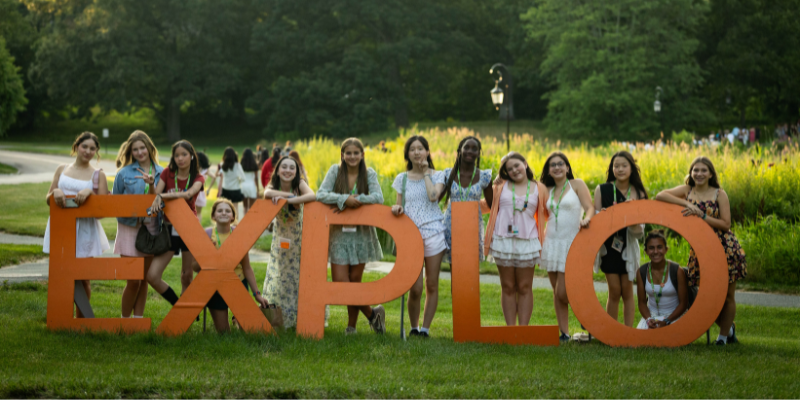
From fostering curiosity to building immersive experiences prioritizing joy, EXPLO has spent 50 years redefining what school can be—and inspiring the educators building what comes next.
“EXPLO shows educators around the world that we can think about the learning outside of the traditional boundaries of the classroom.” —Brian Hamilton
For nearly 50 years, EXPLO has operated as a generative space, an environment where young people are taken seriously and invited to direct their own learning.
But this philosophy doesn’t just impact the students who attend; it also profoundly shapes the staff who teach them, inspiring a new generation of educational leaders and innovators.
Empowering Young Educators
For many years, EXPLO has staffed its programs with energetic and curious college and university students—individuals who are not only passionate about learning but eager to share what they love. From its inception, it has provided an immersive, high-intensity environment where creativity, responsibility, and experimentation are expected.
Over the years, thousands of young people have worked at EXPLO, many of them going on to build careers in education. Among those former EXPLO staff turned education innovators are:
- Jeff Wetzler, co-founder of Transcend, head of Transcend Labs, and author of Ask: Tap Into the Hidden Wisdom of People Around You for Unexpected Breakthroughs in Leadership and Life
- Brian Hamilton, assistant head of school for academic affairs at Deerfield Academy
- Andrew Frishman, Co-CEO at Big Picture Learning
Independently, Jeff, Brian, and Andrew each remember EXPLO as more than a summer job—it was their first real foray into experiential teaching.
EXPLO staff at the time were invited to design their own courses, often the first time in their lives any of them were given this kind of leadership opportunity.
As Andrew Frishman recalls, the experience was transformative: The idea that “I have something that I would want to teach people” shifted how many young educators saw themselves and their role in learning.
Jeff Wetzler recalls being a college sophomore teaching highly creative classes like “Fizz Bang Pop,” a hands-on science course, and “Seeing Is Believing; Or Is It?,” which explored the intersection of psychology, cognitive science, and magic.
Sometimes, they were even challenged to come up with the subject on the fly. Brian Hamilton recalls one summer when the director of programming had listed his name next to a session called “Save the Power Cheerios.”
“I had maybe 45 minutes to figure out what ‘Save the Power Cheerios’ was going to be that day,” says Brian with amusement. “Students had signed up and I would be leading that activity.”
“We had essentially a Cheerios Olympics of some sort. Everyone had a great time!”
Keeping staffers and students on their toes was part of the magic.
“I loved the invitation to take a lot of what might be kind of traditional forms of instruction, putting those aside and thinking, let’s think bigger, let’s think more outside the box there,” says Brian.
To this day, thinking bigger has remained central to the educational philosophies of Brian, Andrew, and Jeff.
Student Agency as the Catalyst for Discovery: Andrew Frishman
For Andrew, that meant thinking differently about the student’s role in learning. He appreciated the sense of agency the young people had at EXPLO.
“What’s exciting about it is that it’s a place where young people are going because they’re looking to develop a sense of independence,” he says. “[At EXPLO], they have the ability to develop or create some of their own identity.”
By “demystifying the college experience,” showing young people they could live independently in the dorm, find their way to the dining hall, and select their own courses, Andrew says EXPLO helped young people develop “a self-directedness that’s really important.”
Learning also went beyond the campus, taking students on “more trips than they would in an entire school year.”
This exposure to a variety of learning experiences, combined with this empowerment to take charge and dig into their own interests, “feels like a sort of eclectic liberal arts exposure,” in Andrew’s view.
“A lot of us who went on to work in education kind of felt like, why can’t school be more like that?”
Where Andrew is Now
This is exactly what Andrew and his colleagues at Big Picture Learning strive to do. Big Picture Learning is an award-winning nonprofit that works with a global network of more than 200 schools, and growing. Their approach focuses on student interests and participatory learning through internships and strong relationships with advisors rather than traditional classroom structures.
“Young people in our network of schools don’t spend five days a week in the classroom,” explains Andrew. “They come to school three days a week, and two days a week they’re going out to internships with businesses and organizations. Over the course of their high school career they might try four or five, six totally different internships to figure out what they do want to do, and what they don’t want to do.”
They get to explore their interests.
Andrew sees student-directed learning not as an alternative but as an essential evolution of education. When students are trusted to pursue their interests, supported by passionate educators, and given opportunities to dig into their ideas in depth, they develop not only knowledge but confidence, independence, and a lifelong love of learning.
Prioritizing Relevance and Access: Jeff Wetzler
For Jeff Wetzler, EXPLO offered an early glimpse of what school could be when it truly connects to students’ interests and the real world.
“What was exciting was the chance for kids to really do hands-on learning that was both rigorous and interesting, and also fun for them—the chance to have an environment of discovery, literally of exploration,” says Jeff, who had been a camp counselor for many summers previously at more traditional summer camp programs before working at EXPLO.
“Kids had choices . . . kids are making and doing things and building things,” he recalls, adding that this approach made learning feel active, personal, and deeply engaging.
That sense of relevance was intentional. Students gravitated toward topics that sparked genuine curiosity and helped them build useful skills.
Where Jeff Is Now
That philosophy has stayed with him throughout his career. In his work today, Wetzler continues to push for models that reflect that same energy and authenticity. “I try to make school more EXPLO,” he says—environments where learning feels “relevant and joyful and engaging,” where kids “get to build things.”
For him, the goal is not just to improve school but to rethink it entirely around what actually motivates and prepares students.
Wetzler’s nonprofit, Transcend, is a national innovation organization that partners with schools and communities to design more relevant, student-centered learning environments. Rather than promoting a single model, it collaborates with educators, students, and families to reimagine school based on local needs, helping create experiences that are personalized, engaging, and aligned with the real world.
For Jeff, collaborating to customize education may have been an idea that was sparked at EXPLO. Jeff recalls a pivotal piece of feedback he received from an EXPLO administrator. “I remember him saying, you seem to have mastered teaching the class as a group, but you need to work on one-to-one relationships with kids,” says Jeff. “I remember that really stuck with me.”
Working at EXPLO also shaped Jeff’s budding interest in education equity.
Whether because of financial, geographical, or other access reasons, not all kids had access to EXPLO or EXPLO-like programs. It struck him, “the difference between what EXPLO provided from what kids with access to fewer resources would get educationally.”
“It also fueled in me a motivation for equity . . . for all kids to be able to have these kinds of experiences,” says Jeff.
With Transcend, he hopes to “reimagine school so that we move beyond this kind of outdated ‘factory model’ of education,” to create environments “where kids love school, like they love EXPLO . . . not just in the summer, not just with kids who can afford it.”
Teaching with Joy and Purpose: Brian Hamilton
EXPLO did, indeed, inspire a passion for learning and education in students, and in teachers, too.
“I think it was at EXPLO that I learned that I love teaching,” says Brian Hamilton, who was an undergraduate American studies major at Columbia when he was on staff with the program.
Not unlike Andrew and Jeff, Brian surmises that his passion was ignited perhaps because of the unique teaching model at EXPLO: less instructor led and more student driven.
Where Brian Is Now
“We always want to begin with where are students at? What do they know and what do they wonder?” This is the philosophy Brian says he still espouses, now in his leadership and teaching role at Deerfield Academy, an independent college-preparatory boarding and day school in Massachusetts.
“EXPLO showed educators around the world that we can think about the learning outside of the traditional boundaries of the classroom,” he adds.
”The other thing it showed him? To find the joy.
“We used to call it happy little motors—the pep talk staff was given on the eve of the students arriving,” he says.
“Our director at the time, Elliot Targum, talked to us about how important it was to project the kind of the enthusiasm that we all felt about the program—and how important that’ll be even when we’re on the edge of exhaustion,” noting that working at a residential program sometimes meant very full days.
Elliot emphasized to Brian and the others “how much that spirit of enthusiasm and energy was not only important for the kids but also important for each other” as a way of building community.
“EXPLO is really where I learned, I think firsthand, the infectious power of enthusiasm, and how important that is to building good culture,” adds Brian.
If he or a colleague at the program were having a tough moment, they’d look at each other and say, “Happy little motors!”
“That still defines my experience now,” he says.
Though it goes by a different name, “happy little motors” is something he’s embraced with colleagues at Deerfield. “It’s important to remember the core mission and the enthusiasm we started the year with,” he says. “Always tap back into that. [Because] we want to show up for kids, always.”
The Future of Education—and EXPLO
“I’m an insufferable optimist about this,” says Andrew, musing on the future of education and today’s generation of learners. “When young people are given the chance to explore their interests and go out and live lives of their own design, good things happen.”
Like their contemporary, Brian and Jeff are also optimistic about the role of education and the possibilities for reinventing old models.
“EXPLO, I think, really has a culture of innovation,” says Jeff. “Let’s try this. Let’s see what works. What do you need to do this? I think we need more of that in education,” says Jeff.
When you think about “what are the set of experiences that you would want young people to have to prepare for adulthood . . . a lot of what happens in conventional schools and classrooms doesn’t really align particularly well,” says Andrew.
On the contrary, EXPLO creates “a really powerful bridge between childhood and adulthood,” creating a set of experiences that nurture young minds into maturity. Andrew has had the privilege of reconnecting with EXPLO in recent years, this time as a parent of his son, Lundy.
As for the future of the program, Brian says, “I expect EXPLO to continue to attract like kind of path-breaking educators that are thinking around the corner on the challenges of education and the possibilities of the classroom and beyond . . . while also giving hundreds of students the best summer of their lives year in and year out.”
.webp?width=352&name=blog%20images%20(1).webp)