.webp)
This summer, find the Tyler.
Last week I headed to Philadelphia to attend the Grandfriend/Special Friend Day at my nephew’s school. It was a lovely visit and I was very impressed with what I saw in the classroom and out. The school visit ended by lunchtime leaving us with the remainder of the day. So I asked Jack, a kindergartener, what he wanted to do. With no hesitation he said, “The Revolution museum.” So we headed to Philadelphia's Museum of the American Revolution. It was, according to his mom, Jack’s fifth visit in the past few months.
The moment we walked through the museum doors, Jack darted toward the exhibit near the front desk and exclaimed that they had changed things around. A surprise. Where had the old exhibit gone? Turns out they had swapped some things around and he wanted me to know exactly what had been switched. He spoke with an air of authority. Jack had a museum agenda that included pointing out what I needed to see, why it was important, what things meant. We put our hands on cannons and cannonballs, he did his unique narration of the short films, and explained troop movements with the casual confidence of someone who had been thinking about all of this for some time.
When I reminded him that I had come down from the Boston area, he told me about Lexington and Concord. Then I told him a few more things I knew about the Revolutionary War – some things he did not know – and he was quiet and attentive, fitting the new information into a map that was already forming in his head. He wasn't being polite. He was hungry.
Then we found Tyler.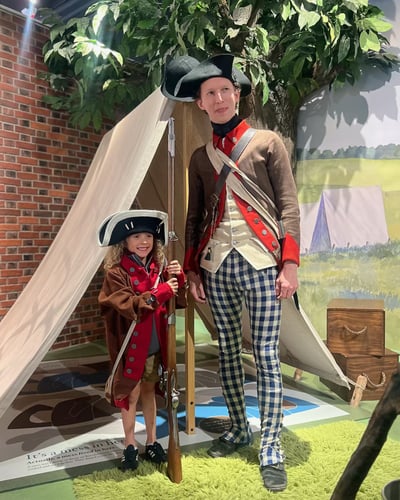
Tyler was a guide dressed in full Revolutionary War garb — a costume, it turned out, that he had sewn himself. He helped Jack suit up in a period-appropriate coat, pack, and musket. Standing there in that gear, Jack learned something no textbook could teach him. He felt how heavy it all was. He understood, in his body, and could begin to imagine what it might mean to march for eight hours carrying that weight. Tyler showed him other things, too, like how to greet a friend or acquaintance with a bow while taking your hat off. There is a bit of choreography needed to pull this off well. Tyler and Jack practiced together a few times.
Jack wanted his photo taken in costume and with Tyler. And in turn, Tyler was so thrilled by Jack, his new young historian friend that Tyler asked a colleague to take a photo of the two of them together. It was a bit of a mutual admiration society. It was a heartwarming scene that attracted a fair bit of attention. Just a group of strangers basking in a sweet kind moment.
On the drive home, Jack told me we hadn't seen everything and needed to go back. He also announced he wanted to visit Lexington and Concord. He had all sorts of questions and comments, “Why didn’t they build rifles that weighed less?” “I think shaking hands is better than bowing.” “I want to sew my own costume.” The comments and questions followed through to the next morning.
* * *
There's an old Finnish proverb I keep returning to: That learned without joy is forgotten without sorrow.
It captures something we all know intuitively but can struggle to act on — that the way learning happens matters. Joy isn't a reward for learning. It's the condition that makes learning stick.
Watch Jack at that museum and you see the difference between learning that fills and learning that fires. The history wasn’t just being poured in — it was being consumed, reorganized, and questioned. He will carry the weight of that soldier's kit far longer than any fact delivered on a worksheet.
This is what experiential learning does. It doesn't just present information. It makes information matter.
* * *
Summer is where sparks can become fires.
The school year is a remarkable thing, but it is often structured around coverage. There's a lot of pail-filling that happens. Summer is different. And right now, every child has at least one spark. Maybe you've seen it: the kid who has watched every nature documentary and wants to find a real tide pool. The one writing fan fiction under the covers. The one who can't stop asking how engines work.
These aren't distractions. They're the leading edge of who your child is becoming.
A few things I've learned about fanning the flames:
Follow the thread. Jack's obsession started somewhere small and has grown into Revolutionary War history, colonial craftsmanship, and a planned trip to Massachusetts. If your child is consumed by something, let it be the curriculum. Pull the thread and see where it leads.
Seek out the Tylers. There is no substitute for a real person who loves what they do and shares it generously. Museums, workshops, maker spaces — these are full of people willing to transmit genuine enthusiasm to a curious kid. That loving transmission is one of the most powerful forces in education.
Let them do, not just observe. Jack didn't just see the coat. He wore it. He didn't just hear about sewing — he asked if he could try. Wherever possible, push toward participation. The hands carry what the eyes forget.
At EXPLO, we think about this constantly. Our programs are built around a simple belief: when young people get to pursue what genuinely interests them — with depth, with peers who share the passion, with adults who take their curiosity seriously — something lasting happens. Not just learning. Something closer to the ignition of a self.
But the ingredients aren't magic. They're the same ones you saw in Jack's afternoon at the museum: a real person who cared, an experience that engaged the whole body, the freedom to follow a question wherever it led. These things are replicable. They show up in a summer program, yes, but also in a road trip, a library, a backyard project, a conversation with the right stranger at the right moment.
You probably already know what lights your child up. You've seen it on their face. You've watched them disappear into something for hours.
This summer, follow that. Find the Tyler. Let them wear the coat.
The habit of being genuinely curious — of chasing understanding for the joy of it — once formed, doesn't go away. Jack doesn't know it yet, but he's learning something bigger than the Revolutionary War.
He's learning what it feels like to love learning. That's the fire worth lighting.
.webp?width=352&name=blog%20(6).webp)