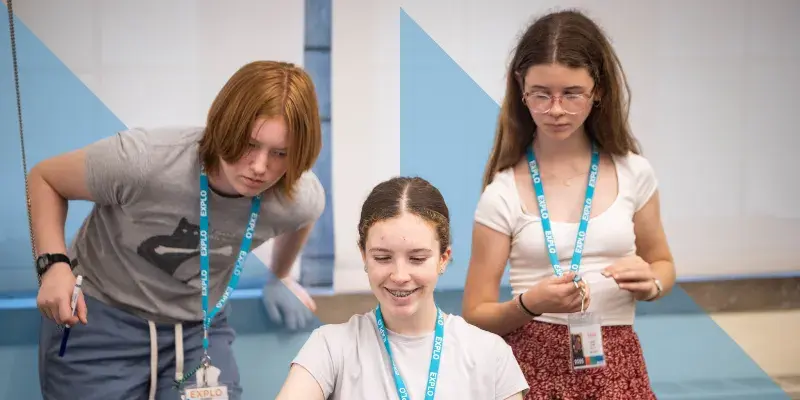
At EXPLO, learning rarely unfolds in straight lines, and it almost never stays confined to a desk.
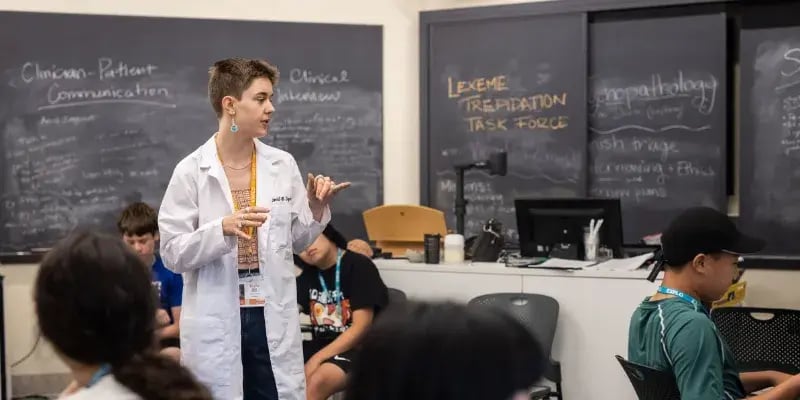
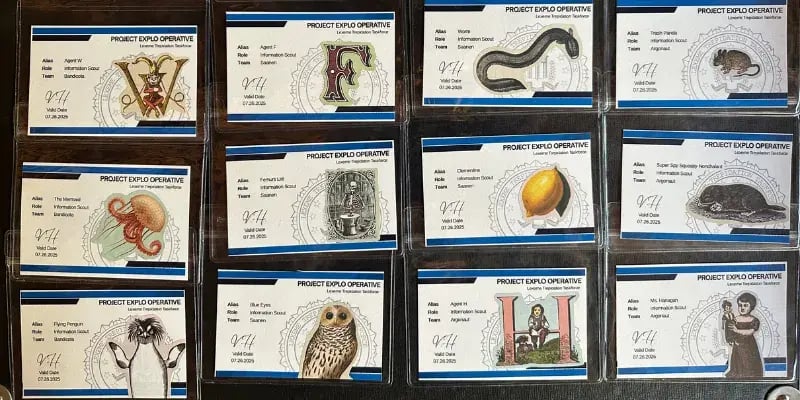
When the Personality and Behavioral Psychology workshop began, students did not walk into what felt like a typical classroom. Instead, they found themselves recruited into the Lexeme Trepidation Task Force, a fictional but fully committed spy agency that had quietly slipped sealed folders under dorm doors earlier in the week. Each envelope posed a question that immediately raised the stakes. What if EXPLO were not just a summer program, but a covert training ground for future spies? What if understanding personality and behavior were not just academic exercises, but essential tools for detecting deception and navigating a world full of misdirection?
By the time the session began, the room carried the hum of something more than curiosity. An indie-pop playlist drifted through the space while students gathered in four groups, their tables scattered with personality profiles, highlighters, and notes. The task in front of them felt strategic and urgent. They were building teams of spies, and they had to do it using established psychological frameworks.
Building the “Perfect” Team
Each group relied on a different assessment model. One analyzed the Myers-Briggs Type Indicator. Another turned to DISC. A third group worked through the Big Five personality traits. The fourth used a color-based personality system. What the students did not initially realize was that the data in front of them reflected their own personality results. As they debated which recruits belonged together, they were quietly sorting themselves.
The conversations were thoughtful and surprisingly nuanced. One student insisted that two dominant personalities could not lead the same team, even as that student confidently steered the group’s discussion. Another argued that a strong researcher might not need to be outspoken in order to be essential. Around each table, roles began to emerge organically. One person read trait descriptions aloud with careful attention. Another organized the notes. Someone else pulled up additional context on a tablet. A fourth weighed the emotional dynamics of each possible grouping. The theory of personality was unfolding in real time through the personalities in the room.
When the Frameworks Disagree
When the groups presented their final spy teams, the twist landed with delighted disbelief. Each framework had produced entirely different configurations. A student labeled a decisive leader under one test appeared as a reflective analyst under another. Someone categorized as a people-oriented communicator in one system became a detail-focused strategist in the next. Laughter rippled across the room as students realized they had been reassigned again and again depending on which model was applied.
One student looked around at a new circle of teammates and said, with genuine surprise, that they were now working with completely different people. That reaction captured the heart of the lesson. If personality tests are often used in schools and workplaces to shape teams and predict performance, what does it mean when the results shift so dramatically depending on the lens applied?
From Theory to Practice: How Middle Schoolers Learn by Doing
The conversation that followed was honest and reflective. A student observed that they had answered questions differently when completing a test alone compared to filling it out in class. Another suggested that these tools might serve as helpful starting points but could never fully capture the complexity of a person. Their reflections echoed a larger truth that psychologists continue to wrestle with, which is that human behavior resists tidy categorization.
Dante, the workshop instructor, offered historical context, explaining that the MBTI was once widely embraced in hiring processes but is now sometimes compared to modern astrology because of its broad generalizations. His tone was not dismissive. Instead, it underscored a central idea that ran through the week’s work. Personality frameworks can illuminate patterns, but they cannot define the entirety of who someone is.
A Classroom Turned Covert Training Ground
The spy theme that framed the workshop was not just a playful hook. Earlier in the week, students had practiced pickpocketing using clothespins, attempting to clip them onto unsuspecting staff members during passing time in order to understand distraction and attention in a visceral way. They had completed incident reports after surprise skits, only to discover how unreliable memory can be when details blur under pressure. Each activity pushed them to confront uncomfortable but fascinating questions about perception. How accurate is what we remember? How easily can we be misled? How often do we believe we are objective when we are not?
What made the workshop powerful was not simply that students learned terminology like extraversion or conscientiousness. It was that they felt the instability of certainty. They experienced how quickly categories could shift and how context could alter interpretation. They saw themselves through multiple frameworks and recognized that none of them told the whole story.
There was a quiet emotional charge in that realization. For adolescents who are often labeled, sorted, and evaluated, the idea that identity is fluid rather than fixed can feel liberating. In that classroom, surrounded by music and scattered personality charts, students were not being reduced to four letters or a color spectrum. They were being invited to question the systems that attempt to reduce them.
The Freedom of Not Being Defined
At EXPLO, we design spaces where young people can test ideas against lived experience, where they can experiment with identity, leadership, and collaboration without fear of being permanently defined by a single result. The Lexeme Trepidation Task Force may have been fictional, but the intellectual and emotional stakes were real.
By the end of the session, the takeaway was not that personality tests are inherently flawed or that psychology lacks value. It was something more nuanced and far more hopeful. Tools can guide us. Frameworks can spark insight. But the most effective teams, and the strongest communities, form when people recognize that they are more complex than any category can contain. In a room full of aspiring spies, what emerged was a deeper understanding that identity is layered, evolving, and shaped as much by experience as by assessment.
Start Your Summer Exploration Journey
Rising 7th, 8th, and 9th graders don't just attend classes at EXPLO—they discover passions, build skills, and explore possible futures. They work through challenging problems, support each other, and emerge with confidence and capabilities they didn't know they had.
Explore EXPLO's summer programs and enroll now for summer 2026.
Part of the Inside EXPLO series: Behind-the-scenes looks at how middle school students explore real-world skills through hands-on summer enrichment at Wellesley College.