-1.webp)
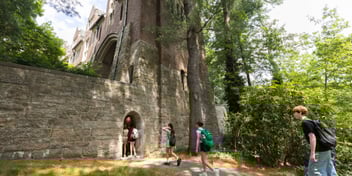
The morning is picture-perfect at Wellesley College. A paddleboarder glides across the lake, dogs trot along the shoreline, and sunlight filters through the trees. Inside the Forensic Science workshop, students gaze out the windows at the peaceful scene.
Then their instructor, Kalpana Acharya, Ph. D, walks in wearing a shirt that reads: "CRIME SCENE: DO NOT CROSS."
The peaceful morning is officially over.
Within minutes, Kalpana receives a phone call from the "Wellesley Police Department" (played convincingly by a fellow EXPLO teacher). There's been a crime. A body has been discovered at the College Club Center. The victim is already at the morgue, but a dummy remains at the scene for investigation purposes. The case is unsolved.
And these middle school students are the forensic team assigned to crack it.
Meet the Investigator: From Research Lab to Crime Scene
Kalpana brings unique credentials to this moment. She spent a decade at Wellesley College conducting neuroscience and psychology research before transitioning into teaching. She understands how to design experiments, collect data rigorously, and draw conclusions from evidence rather than assumptions.
She's also vibrant, funny, and completely comfortable with controlled chaos. She jokes with students but keeps them focused. She celebrates their insights while pushing them to think more carefully. She's exactly the kind of mentor who makes complex science feel accessible and exciting.
"You've all been trained for this type of situation," Kalpana tells her rookie investigators. "They've given us a big responsibility. What are the first things we need to do?"
"Find the crime scene!" someone shouts.
"We can't just show up and run around," Kalpana responds. "We need to go over the rules and the order we do things."
This is the difference between watching CSI and actually understanding forensic work. Real investigations require protocols, patience, and precision.
Building the Investigation Team
A student reads the police report aloud. It includes witness statements, background on the victim, and a list of forensic tests that need to be run. The witnesses are all EXPLO staff members—including the Director of Programming and Dean of Students. Suddenly, this fictional crime has gotten very real, at least in the students' imaginations.
Kalpana distributes Investigation Tracker sheets, which are official forms where teams will document every piece of evidence, every observation, every hypothesis.
Students are assigned specific roles:
- Team Lead (coordinates the investigation)
- Notetaker (documents everything)
- Evidence Processor (handles physical evidence)
- Photographer (captures the scene before anything is touched)
These roles mirror how real forensic teams operate, with each specialist contributing expertise while maintaining the chain of custody and investigative integrity.
"Before we get there, we can't touch anything without what?" Kalpana asks.
"GLOVES!" the room shouts in unison.
"Exactly. Today's job is to collect everything from the crime scene. We won't process everything today, but we need to get all of the evidence, alibis, anything we need. Write EVERYTHING down! Photograph before you touch. And no contamination."
The Crime Scene: Where Theory Meets Reality
Behind the building, the mock crime scene awaits. A dummy lies on the ground. Nearby: a single boot, a Dunkin' Donuts card, and traces of blood—both a footprint and spatter marks.
The scene may be staged, but the investigative process is authentic.
-1.webp?width=800&height=400&name=blog%20(3)-1.webp)
Students snap into action, each fulfilling their assigned role. Photographers circle the scene, capturing it from multiple angles before anyone touches anything. Sketch artists draw diagrams showing the spatial relationship between evidence pieces. The notetaker logs observations: weather conditions, time of discovery, position of the body.
Evidence processors pull on gloves and carefully bag items—the boot, the Dunkin' card with its visible fingerprint, and hair stuck to the surface. Everything gets labeled, dated, and documented.
It's fascinating to watch how many simultaneous activities occur at a crime scene. When you see investigations on television, you notice lots of people milling around, but you rarely think about what each person is actually doing. Here at EXPLO, students experience the choreography of forensic work—the careful coordination required to preserve evidence while documenting everything thoroughly.
Kalpana circulates through the scene, reminding students of techniques they've learned and pointing out evidence they've missed. She doesn't solve anything for them. She guides their observation.
The Devil Is in the Details: Learning to Analyze, Not Assume
Students huddle over the bloody footprint, comparing it to reference prints of the suspects. Some declare it matches the Director of Programming's shoe. Others think it might be the Dean's.
"Just because you have a footprint that looks like someone's shoe doesn't mean you can prove it was them," one student cautions her team. "So we're not wrongly accusing anyone. We don't have enough to accuse now."
This is the key insight: correlation doesn't equal causation. Evidence that suggests something isn't the same as evidence that proves it. The student's instinct to wait for more data before making accusations demonstrates exactly the kind of critical thinking that EXPLO encourages.
The methodical approach matters. Forensic work isn't about dramatic "aha!" moments—it's about systematic collection and analysis. It's about resisting the urge to jump to conclusions and instead building a case piece by piece.
Tomorrow's Lab Work: From Scene to Science
As the evidence collection wraps up, students head back to the classroom with their carefully bagged materials and detailed documentation. Tomorrow they'll move to the next phase: laboratory analysis.
They'll use microscopes to examine the hair found on the Dunkin' card, looking for characteristics that might link it to a suspect. They'll apply fingerprinting dust to lift the print and compare it against known samples. They'll analyze blood spatter patterns to determine what they reveal about the crime's circumstances.
Each piece of evidence will be processed using the same techniques employed by real forensic scientists in actual investigations. The hair analysis follows standard protocols. The fingerprinting uses authentic methods. The documentation mirrors what would be submitted in court.
-1.webp?width=800&height=400&name=blog%20(2)-1.webp)
The Intersection of Science and Ethics
What makes this workshop particularly valuable is how it weaves together multiple dimensions of forensic work. Students are learning more than just scientific techniques—they're grappling with ethical questions:
- When do you have enough evidence to accuse someone?
- How do you avoid contaminating a scene?
- What's the difference between a lead worth pursuing and speculation?
- How do you balance thorough investigation with the urgency of solving a case?
These questions extend far beyond forensic science. They're fundamental to scientific research, medical diagnosis, legal reasoning, and investigative journalism. They're about learning to think rigorously in situations where getting the answer wrong has consequences.
The EXPLO Difference: Where Fiction Serves Reality
From the outside, it might look like kids are playing detective. And in a sense, they are—but they're playing in a way that teaches genuine professional capabilities.
That's the magic of EXPLO's approach to summer enrichment. The simulation creates engagement and emotional investment, but the techniques are real, the thinking is rigorous, and the skills transfer directly to academic and professional contexts.
Kalpana doesn't need to convince students that forensic science matters. The crime scene does that. She doesn't need to force them to pay attention to detail. The evidence demands it. She doesn't need to lecture about the importance of protocols. Students discover it when contamination ruins a fingerprint or poor documentation makes evidence unusable.
The learning is embedded in authentic practice, which means students aren't memorizing facts for a test—they're developing capabilities they'll use in countless future situations.
By the end of tomorrow's lab analysis, these middle schoolers will have processed a complete crime scene investigation from start to finish. They'll have practiced the systematic thinking that defines good science, good medicine, good law, and good reasoning in general.
They'll have learned that truth isn't about what seems obvious—it's about what the evidence reveals when you're patient enough to gather it properly and careful enough to analyze it rigorously.
Join the Investigation This Summer
Rising 7th, 8th, and 9th graders don't just take classes at EXPLO—they step into professional roles, tackle real challenges, and discover capabilities they didn't know they had.
Explore EXPLO's summer programs and enroll for summer 2026.
Part of the Inside EXPLO series: Behind-the-scenes looks at how middle school students explore real-world skills through hands-on summer enrichment at Wellesley College.