If you walked past the Jewett Arts Center auditorium on a Wednesday morning at EXPLO, you'd hear something strange. Inexplicable sounds. Bursts of laughter. The unmistakable noise of organized chaos. You might wonder what on earth is happening inside.
Welcome to Comedy: Improv + Beyond, where rising 7th, 8th, and 9th graders discover that improvisation isn't just about being funny, but about listening, responding, taking creative risks, and building something meaningful with other people in real time.
The Stage Is Set for Summer Exploration
The black-curtained stage still holds remnants from last night's Talent Show—piano benches, music stands, and lingering memories of ballet solos, diabolo juggling stunts, and even a skit featuring the Dean of Students. But this morning belongs to a different kind of performance: one where nothing is scripted and everything matters.
Leading the workshop is Ryan, a theater teacher from Francis W. Parker Charter School and a nearly ten-year EXPLO veteran. His energy fills the auditorium. He's the kind of educator who celebrates mess-ups, encourages the weird, and ensures everyone feels safe to try something unexpected.
That last part is crucial. On the wall hangs a poster with EXPLO's Community Expectations: Be Kind. Be Safe. Be True. Be Curious. In a theater workshop where vulnerability and silliness are essential ingredients, these words are the foundation that makes creative risk-taking possible.
From Silence to Sound: Building Focus Together
Students arrange chairs in a circle on stage. The first exercise is deceptively simple: a game called Focus.
Eyes closed, the group must count down from 20 to 1—one number per person, one voice at a time. If two people speak simultaneously, they start over.
The auditorium goes silent. Twenty... nineteen... eighteen... The first few numbers flow smoothly. Then the pace slows. Students must intuit when to speak, sensing the group's rhythm without any visual cues.
Against all odds, this group nails it on the first try.
Ryan is stunned. "That never happens the first time in a theater class."
One student shrugs: "Just be patient."
This simple game teaches a profound lesson about collaboration—sometimes the most powerful contribution is knowing when not to speak.
The Beauty of Making Mistakes Together
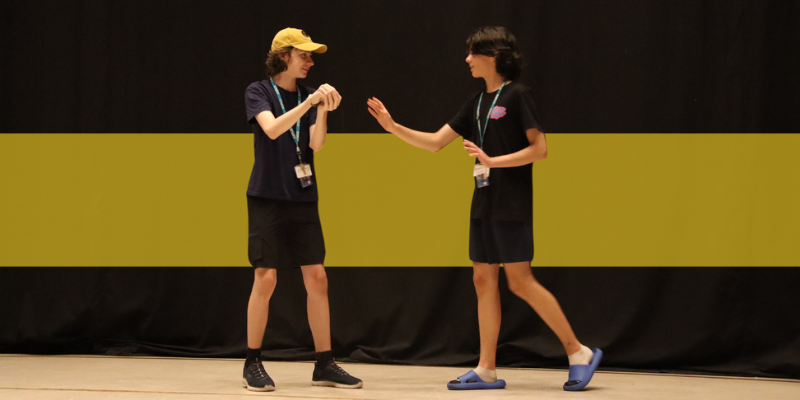
Next comes a partner rhythm game where students create hand motions while staying out of sync with their partner. Ryan explains, "You're trying to make it so that you're always doing something different than your partner—you don't want to be a mirror in this game."
As soon as the game starts, giggles erupt. Partners lock eyes, trying to anticipate each other's moves while deliberately choosing different ones. Some groups are intensely focused. Others can't stop laughing.
Ryan pauses for reflection: "How are we doing?"
"We do the same motion every time," admits one group.
"We were making a pattern," says another. "We made a few mistakes and then we realized we could establish a loop."
Ryan adds a new challenge: you can't repeat the same motion twice in a row. He increases the tempo. The laughter gets louder as coordination dissolves into cheerful chaos.
"How did that go?" Ryan asks.
"Terrible!" someone shouts.
Ryan smiles. "It seems like you stayed in rhythm even when you messed up!"
Success in improvisation—and in life—isn't about perfection. It's about maintaining presence and commitment even when things go sideways. The rhythm matters more than getting every move right.
.png?width=800&height=400&name=blog%20images%20(2).png)
King Frog: When Simple Rules Create Complex Challenge
After moving chairs to the edges to create more space for movement, the class plays several games building physical awareness and quick reactions. Then Ryan announces they're taking a "detour from improv" to play King Frog.
Students then return to their tight circle of chairs. Each person invents a unique sound and action. They practice around the circle, memorizing everyone's contributions. Some students create theirs instantly; others pause to think carefully.
Here's where it gets interesting: when someone messes up, they move to the end of the circle—and everyone else shifts down one seat. Suddenly, everyone has a new sound and action to remember.
Groans fill the auditorium as they realize what this means.
Ryan admits cheerfully, "I'm very, very bad at this game, but I love to play it."
True to his word, Ryan messes up repeatedly. The students laugh harder each time their teacher fails, creating an atmosphere where mistakes are celebrated. Rules get added, increasing complexity. The challenge grows.
When the game finally ends, several kids immediately ask to play again.
Ryan suggests, "Get a group of friends outside class and teach it to them."
At EXPLO, students don't just consume experiences; they become evangelists, spreading joy and learning to their wider community.
Real Improv: Building Characters from Nothing
Now comes the heart of the workshop: actual improvisational performance. The game is "How Do I Know You?"
Two students volunteer to sit in the middle of the circle while everyone else plays an interviewing press corps, asking questions about their lives and relationship. They have to come up with backgrounds and characters on the fly.
Ryan reminds them of improv's golden rule: "Yes, and..." Affirm what your partner says, then add new information. Build together.
"Where do you work?"
"A chair company."
"And wigs—Chairs and Hairs."
The audience erupts. Already these middle schoolers are discovering comedic timing and the power of unexpected combinations.
Ryan introduces a new layer: he has a bell. When he rings it, the answer must change immediately.
"What do you think of each other's hair?"
"It's okay."
Ding.
"It's bad."
Ding.
"It's really great, I love it!"
The bell creates delightful pressure. Students must abandon their first instinct and find something new on the spot.
"What do you think about apples?"
"I love them!"
Ding.
"I prefer lemons."
As the game continues, Ryan ups the challenge: no more one-word answers. Now performers must speak in fuller sentences with more detail. Suddenly the improvisation deepens. Characters emerge. Backstories develop. The audience asks more thoughtful questions, following threads of information the performers have provided. The students aren't just playing anymore—they're creating genuine collaborative fiction in real time.
.png?width=800&height=400&name=blog%20images%20(1).png)
The Space Between Structure and Chaos
What makes Ryan's workshop work is the careful balance between structure and freedom. Each game has clear rules that create a safe container for creativity. Within those boundaries, anything can happen.
To an outsider, it might look like controlled chaos. But inside the circle, every student knows exactly what's happening—they're practicing:
- Listening actively to build on each other's ideas
- Thinking quickly when unexpected questions arrive
- Staying present rather than planning ahead
- Embracing mistakes as part of the creative process
- Supporting teammates through encouragement and acceptance
These skills translate far beyond the stage.
Why Improv Matters for Middle Schoolers
Adolescence is already improvisation. Every social situation, academic challenge, and personal decision requires navigating uncertainty with limited information. Middle schoolers face constant pressure to have the "right answer," make the "right choice," and project confidence they may not feel.
Improv training offers something radical: permission to not know, to try anyway, and to trust that mistakes are data rather than failures.
When Ryan demonstrates that he's "very, very bad" at King Frog but plays anyway with full enthusiasm, he's modeling a life skill more valuable than any memorized script: the ability to show up, participate fully, and laugh at yourself when things go wrong.
When students affirm each other's ridiculous ideas—"A chair company." "And wigs!"—they're learning to build on diversity of thought rather than compete for the "best" idea.
When they stay in rhythm even while messing up the hand motion game, they're discovering that consistent effort matters more than flawless execution.
EXPLO's approach to middle school summer exploration recognizes that the most important learning often happens in the margins—in how a teacher responds to mistakes, how peers support each other during challenges, how community expectations get reinforced through action rather than lecture.
Join the EXPLO Community This Summer
Rising 7th, 8th, and 9th graders don't just take classes at EXPLO—they discover what they're capable of when given skilled instruction, supportive community, and permission to try, fail, and try again.
Explore EXPLO's summer programs and enroll for summer 2026.
Part of the Inside EXPLO series: Behind-the-scenes looks at how middle school students explore real-world skills through hands-on summer enrichment at Wellesley College.
.webp?width=352&name=blog%20(6).webp)