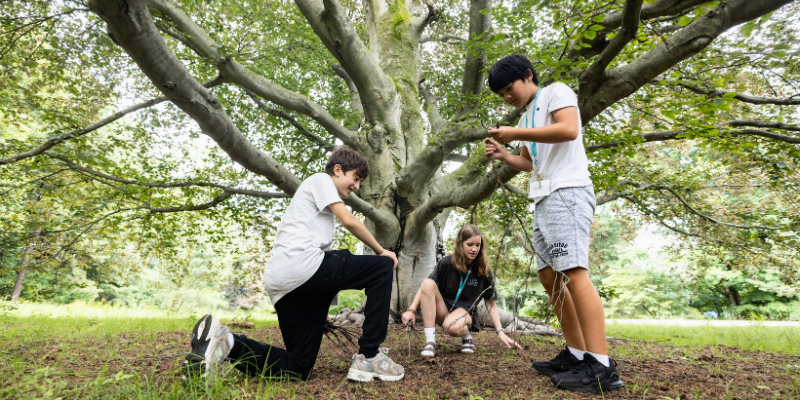
It is the kind of summer afternoon that feels almost staged in its perfection. The sun hangs high above Wellesley College, clouds drifting lazily across an open blue sky, while a group of young explorers gathers beneath the trees near the McAfee quad fire pit. The heat lingers in the open air, but under the canopy it is cool and breezy, the kind of shade that invites both focus and possibility.
Today’s objective is straightforward and unmistakably bold: they are going to build a fire. EXPLO students will create flame from raw materials, relying on what they can gather and what they understand.
This is Wilderness Survival at EXPLO, and ignition is the lesson.
The Science Before the Spark
Instructor Katherine begins with context rather than matches. She walks the group through the science of combustion, describing how fire depends on a careful balance of fuel, oxygen, and heat. She explains why thin twigs catch more easily than thick branches and how the structure of a fire—teepee, log cabin, or lean-to—determines the way air circulates through the stack. The shape they choose, she tells them, will either encourage a flame to grow or quietly suffocate it.
The instruction is concise and practical, and then she gestures toward the woods. Their task is clear: gather what they will need to build a real, working campfire.
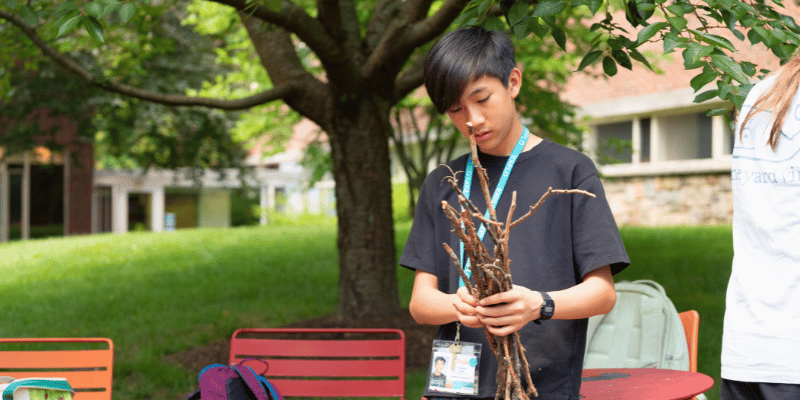
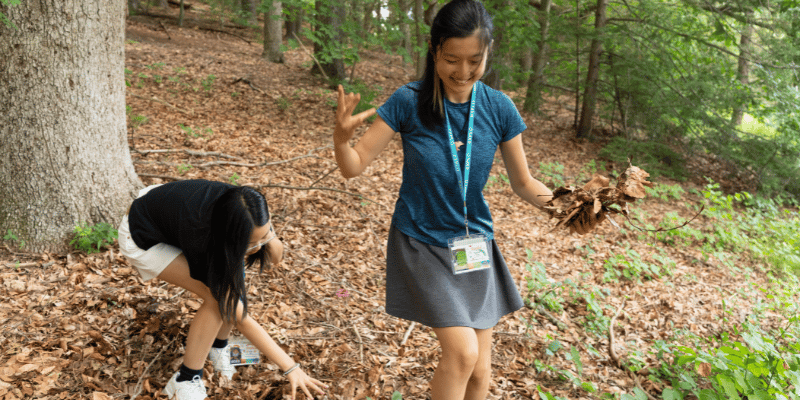
The shift from theory to action is immediate. One student triumphantly drags an enormous tree limb toward the pit, its size ambitious if not entirely practical. With encouragement, the group begins breaking it down, the sharp crack of splintering wood echoing through the trees as thick branches are reduced to usable pieces. Others return with armfuls of dry leaves and bundles of slender twigs, comparing textures and debating which pieces feel driest.
Questions ripple through the group—what belongs at the center, when to introduce larger sticks, how tightly to stack the structure—but Katherine resists the impulse to intervene. She has offered guidance; now the decisions belong to them. Fire, she tells them, offers immediate feedback.
Strategy + Teamwork
Around the pit, collaboration takes shape as naturally as the fire structure itself. Sticks are sorted from smallest to largest and arranged like components of a carefully organized toolkit. Leaves are layered into a soft nest at the center, and a loose teepee form begins to rise around it. The group hovers close, adjusting angles and spacing, quietly aware that airflow will determine their success.
When the first ember glows, the atmosphere shifts from anticipation to concentration. Smoke threads upward in thin spirals, wavering as if undecided. The leaves darken and curl, and for a moment the effort seems suspended between failure and flame. Rather than unraveling, the group leans further into the challenge, subtly rearranging a stick here, easing a heavier branch aside there, and feeding the structure smaller pieces that allow oxygen to circulate more freely. Someone kneels and blows gently at the base, and the ember brightens in response.
Gradually, the smolder sharpens into flame. What begins as a hesitant flicker steadies into something more confident, and the fire takes hold, climbing from twig to twig. The cheers that follow are brief, replaced almost immediately by a new understanding that maintaining a fire requires as much care as starting one. Larger sticks are added thoughtfully, one at a time, each placement considered so the flames continue to breathe and grow rather than collapse under their own weight. Before long, the scattered materials they carried from the woods have transformed into a steady, crackling fire that radiates heat and accomplishment.
The Sweet Reward
When the fire has settled into a reliable burn, Katherine reaches into a bag and produces marshmallows, graham crackers, and chocolate. The transition from survival exercise to celebration feels less like a reward tacked onto the end and more like a natural continuation of the experience.
Students sharpen sticks they collected earlier and hold their marshmallows over the coals, watching closely as the surfaces blister and turn golden. Some rotate theirs patiently, coaxing an even caramel color, while others embrace the drama of a briefly flaring flame before blowing it out. Laughter drifts upward with the smoke, mingling with the scent of toasted sugar and wood.
Then comes a surprise treat: banana boats. Katherine demonstrates how to slice a banana lengthwise without removing the peel, tuck chocolate and marshmallows inside, wrap the whole thing in foil, and nestle it into the embers. When unwrapped, the result is warm, molten, and unmistakably campfire-approved, the sweetness deepened by the memory of the work that made it possible.
Beyond the Fire Pit
The afternoon’s fire is only one chapter in a broader exploration of wilderness skills unfolding across Wellesley’s expansive campus. In previous sessions, students have practiced pitching tents and constructing basic shelters, learning how small adjustments in tension and placement can determine whether a structure stands firm or sags overnight. They have identified edible and unsafe plants, filtered lake water for drinking, and rehearsed the steps of wilderness first aid, building a toolkit of knowledge designed for both independence and responsibility.
Wellesley’s 500-acre campus, including 200 acres of protected woodlands and winding trails, offers an environment that feels removed from everyday routines, even though Boston sits less than twenty miles away. The landscape provides room to experiment, to get a little muddy, to problem-solve under open sky while still guided by experienced instruction.
Before the session ends, the group gathers once more to review how to extinguish a fire properly and how to respond to potential burn injuries. No one has been hurt, but the conversation underscores an essential truth: survival is not about spectacle. It is about preparation, attentiveness, and respect for the elements.
Watching Effort Become Flame
As the fire gradually dims and the last crumbs of graham cracker disappear, what lingers is not just the taste of melted chocolate but the memory of transformation. Smoke that once drifted uncertainly above a pile of leaves has become a steady flame because a group of students chose to experiment, observe, and adjust together.
In the shade near McAfee quad, they experienced firsthand how knowledge translates into action and how collaboration can turn a fragile spark into something strong enough to warm an entire circle. The fire may have been the focal point, but the real lesson was quieter and more enduring: when strategy, patience, and teamwork align, even the smallest ember can grow into something lasting.
Start Your Summer Exploration Journey
Rising 7th, 8th, and 9th graders don't just attend classes at EXPLO—they discover passions, build skills, and explore possible futures. They work through challenging problems, support each other, and emerge with confidence and capabilities they didn't know they had.
Explore EXPLO's summer programs and enroll now for summer 2026.
Part of the Inside EXPLO series: Behind-the-scenes looks at how middle school students explore real-world skills through hands-on summer enrichment at Wellesley College.
.webp?width=352&name=blog%20(3).webp)